The Communications Paradigm Problem: Are We Really Listening?
We’ve all been there. Your friend calls to invite you to her birthday party this Saturday. Grateful for the invite, you respond that yes, you’ll be there, but would you mind keeping the party nut free? Last time, the chicken cordon bleu gave you a bad allergic reaction (why did the breading have pistachios?). Of course, she hurriedly promises, then hangs up.
Gift in hand, you arrive at her party on Saturday surrounded by friends. You’re enjoying yourself until you realize what’s on the dinner menu: chicken cordon bleu.
While you love your friend, your relationship has weakened because she listened without really hearing.
What is the communications paradigm?
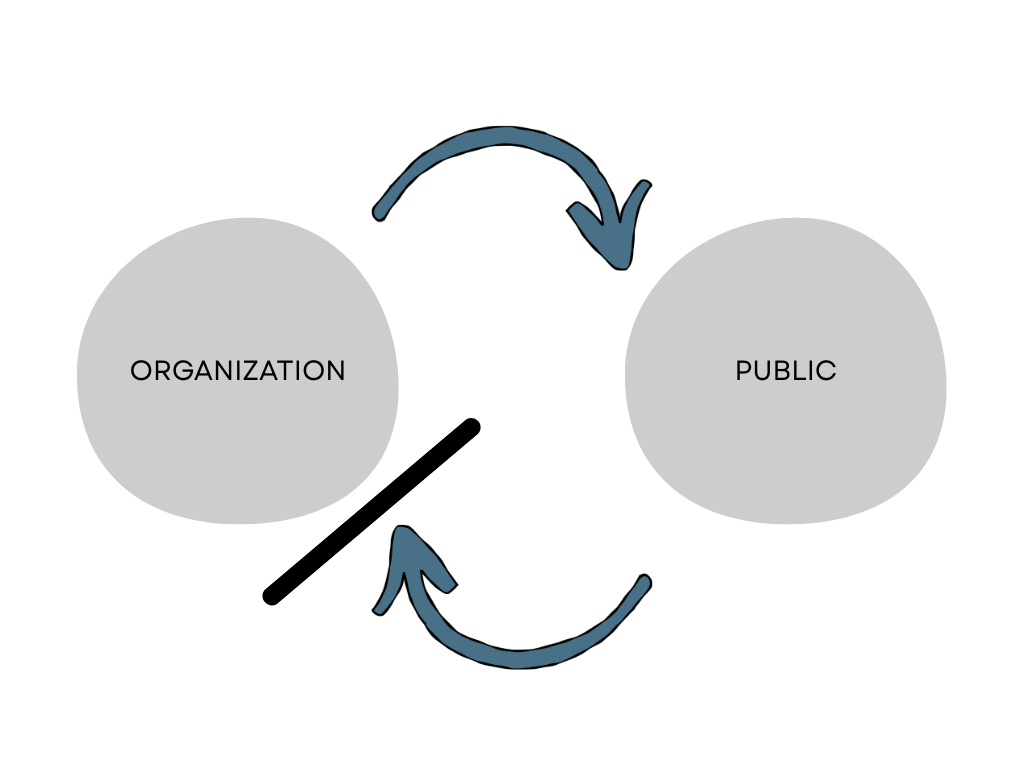
In the communications paradigm, an organization transmits a message to its public, such as an ad for a new product or a message to change behavior. They set aside negative comments as a fraction of the public, enjoy the positive responses, and give themselves a pat on the back for a job well done.
Dr. Christopher Wilson, a public relations professor at Brigham Young University, said, “I think a lot of times what happens in our industry is we focus a lot on the talking, but we don’t do a lot of listening.”
In the communications field, public relations is unique because it focuses on relationship building, which involves two-way communication. Active listening and action-based responses are more important than ever in building relationships between organizations and key publics. The key to going beyond listening is learning to leverage social listening technology to translate feedback into organizational action.
As a project manager at BYU’s Student-run Firm, I provide clients with data-backed insights derived from really listening to key publics. We use industry software programs, including Muck Rack and Meltwater, to conduct social listening and analysis. In this article, I will summarize several advantages and disadvantages of these platforms to help young PR professionals gain confidence in listening to key publics and recommending appropriate organizational action.
A comparison of Muck Rack and Meltwater
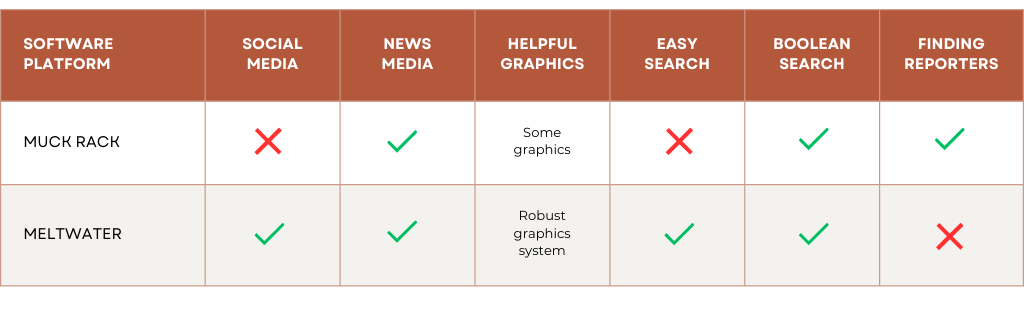
Muck Rack is my go-to for media listening via news media. Searching by topic, I find hundreds of articles that relate to my campaign (filters are Muck Rack search’s superpower). Then, creating a dashboard helps me analyze trends in sentiment, reach and outlet. These graphics, while helpful, are few in number. What Muck Rack lacks in graphics it makes up for in media relations capabilities. Muck Rack does a fantastic job of identifying reporters by beat (including their contact information), compiling media lists and streamlining the media pitch process.
In contrast, Meltwater is ideal for listening via social media. It provides an incredible array of charts and graphics to transform data into a story. There are literally dozens of options to choose from. One of my favorite ways to provide context for data is to compare a current campaign or crisis with a similar one from the past. Overlaying this data provides perspective and builds credibility. The biggest downside is that Meltwater mainly pulls from X, which is important for every PR professional to keep in mind.
One last caveat: Automated software programs can make mistakes. Angela Dwyer, APR, VP of Insights at FullIntel, explained, “It’s great to use AI, but sometimes an automated tool just doesn’t look at things the right way. Say it’s bucketing cancer as negative but really, we’re looking at a brand that cures cancer, right?” It’s important to use these platforms as a tool, while using your trained, analytical mind to interpret the data correctly and meaningfully.
Pro Tip: Free listening certificates
Even if you do not have a subscription to these programs, you can still get certified in social listening through their free courses (and boost your resume and LinkedIn profile).
Here are my favorite courses from Muck Rack and Meltwater:
Muck Rack: Media Monitoring and Reporting
Bonus: for those interested in media relations
Muck Rack: Fundamentals of Media Relations
The proper pattern for a communications paradigm
So, you’ve done your due diligence with social listening and you’ve really heard your publics’ feedback. As entry-level PR practitioners, how do you and I help our organizations respond appropriately, effectively switching from chicken cordon bleu to an allergy friendly sushi bar (yum)?
As Dr. Wilson explained to me, it would be a disservice to our client if we kept this information to ourselves. With confidence, we can share the data-backed insights we have found with those above us. Our job is to send this information up the chain, so that those in charge can make an informed decision about how to respond. When they do, then it will be our turn again to relay that information outward.
This cyclical, mutual communication pattern is the proper communications paradigm. Our responsibility is not just to inform the public on behalf of our organization, but also to inform our organization on behalf of the public.
Where will that lead us? To a thrilling ride of lifting organizations and publics together, through both communication and action.

Alicia Matthews is a junior at BYU studying Public Relations, with a passion for advocacy, authenticity and respectful communication. As a project manager at BYU’s PR Intelligence Lab, she leads a team of 20 students in qualitative and quantitative research. When not at school or work, she can be found reading, singing or speaking Spanish. Connect with her on LinkedIn.