The Indispensable Strength: Why Black Voices Are Essential to Public Relations
The public relations industry, at its core, is about communication. It is about understanding diverse audiences, crafting resonant messages, and building authentic relationships. To truly excel, public relations must reflect the rich tapestry of the society it serves. This is precisely why the amplification and inclusion of people of color, such as Black voices within the profession are not merely a matter of equity, but a strategic imperative.
For too long, the public relations landscape has struggled with diversity. While progress is being made, statistics continue to show an underrepresentation of Black professionals, particularly in leadership roles. This demographic imbalance represents more than a missed opportunity; it is a significant weakness that can hinder a brand’s ability to effectively and authentically connect with an increasingly diverse marketplace. Because of this, it is important to make intentional efforts to include Black voices in the public relations process.
One PRSSA student shared a powerful perspective on why Black representation in public relations spaces is so vital: “As a Black student pursuing a career in public relations, it is powerful to see people who look like me excelling in a space I aspire to lead in one day. Having a seat at the table allows Black voices to be heard and make significant contributions, while showing students like myself that this industry welcomes us, our ideas, our history, and our stories. The PRSSA community reinforces that sense of belonging and affirms that Black voices are essential to the future of this profession, and for that, I am truly grateful.” — Anyah Griffin, Hampton University
Black professionals bring invaluable perspectives, cultural insights, and lived experiences that are essential for navigating today’s complex communication environment. They possess an inherent understanding of cultural nuances, historical contexts, and community dynamics that can prevent missteps and foster genuine engagement. Without these voices at the table, campaigns risk being tone deaf, culturally insensitive, or ineffective, failing to resonate with or alienate key demographic audiences.
Here’s another student’s perspective: “As a Black student pursuing a degree in public relations, representation and the amplification of Black voices are essential. Public relations cannot effectively engage culture without Black voices at the table. From music to entertainment to social trends, Black communities drive influence which makes our perspectives essential to meaningful and responsible storytelling.” – Amyah Gibson, Clark Atlanta University.
Consider a brand launching a product intended for a broad consumer base. If the team developing the communication strategy lacks diverse perspectives, it may inadvertently overlook crucial cultural sensitivities or miss opportunities to connect on a deeper level. A Black public relations professional, drawing on their unique background, can identify potential pitfalls, recommend inclusive language, and advocate for authentic representation that genuinely resonates with diverse audiences. This ensures the messaging is not merely broadcast, but truly heard and valued.
Beyond cultural competence, Black public relations professionals contribute to a more innovative and resilient industry. Research consistently shows that diverse teams are more creative, more effective problem solvers and stronger decision makers. When a variety of viewpoints are present, ideas are challenged, assumptions are questioned and new solutions emerge. This intellectual synergy is essential in an industry that depends on creativity and adaptability amid rapidly evolving communication trends.
Additionally, the visibility of Black professionals in public relations leadership roles serves as powerful inspiration and mentorship for future generations. When aspiring students of color see themselves reflected in positions of influence, it validates their ambitions and reinforces that a career in public relations is both accessible and attainable. This representation is critical for cultivating a strong pipeline of diverse talent and fostering a more inclusive professional community.
Organizations that demonstrate a genuine commitment to diversity, equity, and inclusion (DEI) are also perceived as more credible and trustworthy by consumers. In an era where corporate values are closely scrutinized, a diverse workforce, particularly in external-facing roles like public relations, reinforces a brand’s integrity and alignment with its stated principles. This commitment can enhance brand reputation, strengthen consumer loyalty, and support long-term success.
To move forward, the public relations industry must actively work to dismantle systemic barriers and create inclusive environments where Black professionals can thrive. This effort includes intentional recruitment, equitable promotion pathways, meaningful mentorship opportunities and cultivating workplace cultures where all voices are not only heard but respected and acted upon.
Embracing and empowering Black voices in public relations is not about fulfilling an obligation. It is about strengthening the profession as a whole. It is about building communication strategies that are authentic, inclusive and impactful, and about shaping an industry that truly upholds its mission of fostering understanding and trust in a diverse world.

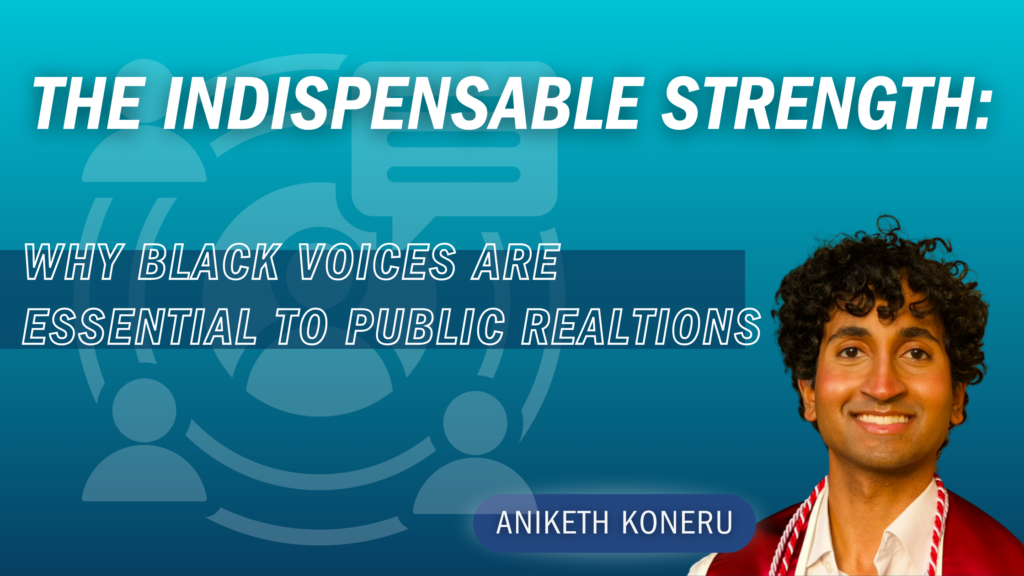
Aniketh Koneru, PRSSA’s 2025–2026 Vice President of Belonging, Equity, Diversity, and Inclusion, is a communication master’s student at Northwestern University. He champions inclusivity, student advocacy, and data-driven PR, building on leadership roles from his time at the University of Oklahoma.