What does it mean to be Persuasive? – What Competitive Debate Has Taught me About Strategic Communications
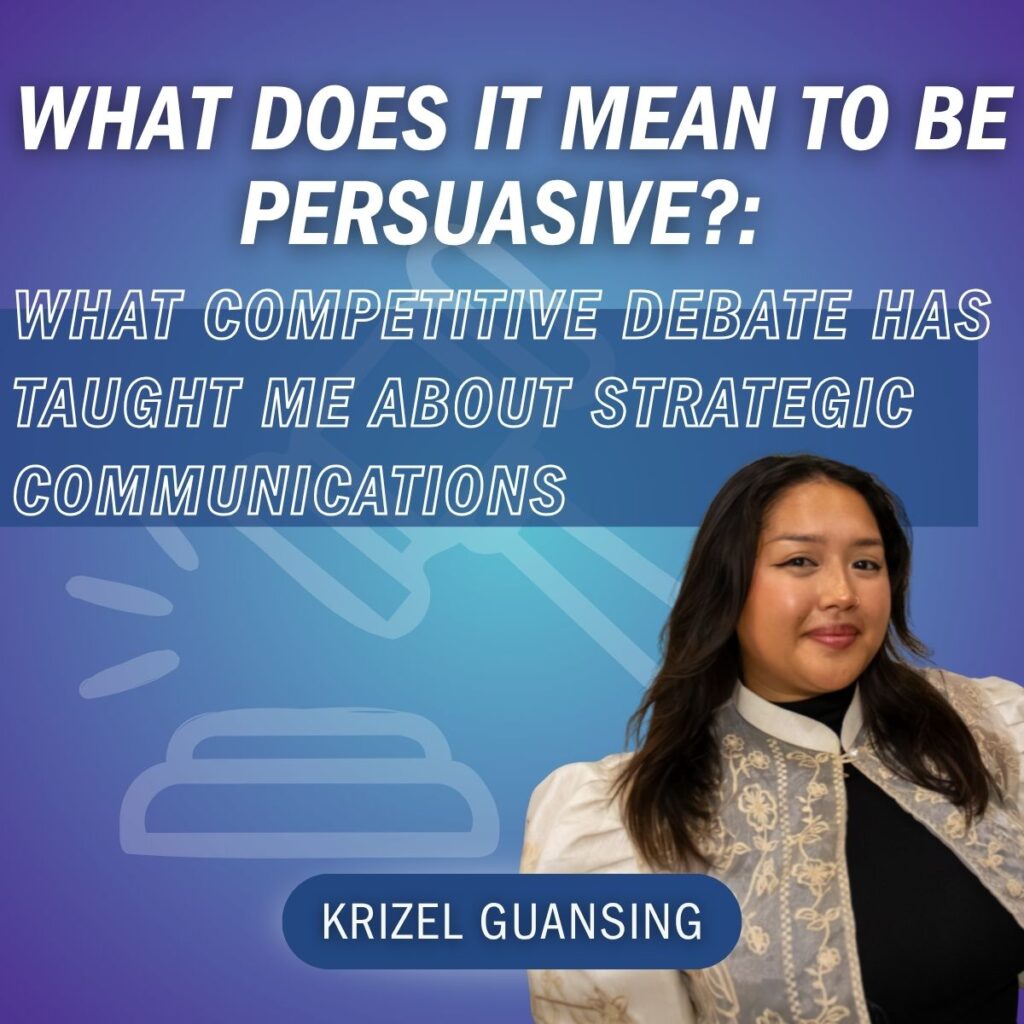
There’s a part of my life that has nothing to do with a Public Relations pitch — and everything to do with how I form one. My not-so-secret double life away from public relations is being a collegiate policy debater and high school debate coach.
Almost every weekend I’m at a different high school campus or college lecture hall, frantically typing arguments on my laptop while sipping on a drink that contains way too much caffeine. Eventually, the rounds blur together: students speaking faster than most people can think, judges scribbling notes and the quiet anxiety before a decision is made.
Policy debate is not what most people picture when they hear that I do debate. There aren’t podiums, polished talking points or clean turns to speak calmly. It is a highly technical, rules-based game where debaters speak more than 300 words per minute, argue over dense policy literature and can win or lose on a technicality. Accessibility is not the point. Winning is.
During elimination rounds, you go from having one judge to a panel of three. The challenge with a persuasive activity is that you have to convince at least two judges that you won — and they can have entirely different ideas of what winning even looks like. One judge might prefer the technical strategy that goes into argumentation. Another might prefer looking at the bigger picture of an argument. All panels require knowing your audience before you even open your mouth.
I didn’t realize how much debate had shaped my communications instincts until I found myself in a different room making my own PR pitches.
The Research
During practice, my coaches always said, “90% of the debate is won before the debate even starts.” Because policy debate is a research-based activity, half of the battle is ensuring that you’ve researched every anticipated argument before you get to the tournament. Without knowing it, Ken Hagihara, California State University, Fullerton’s PRSSA faculty adviser, told me the same thing when I was drafting a PR pitch to our client at PRactical Advantage.
Hagihara instilled in me the importance of strategic communications backed by research. You should be able to explain why exactly your PR plan will be successful. Before you can pitch anything, you need to know the client, know their audience and know the answer to every question, because in both a debate round and a PR pitch, the preparation is the strategy.
The Pitch
The other half of the battle in debate is time. Every second spent on an argument that isn’t landing is a second you can’t get back. The best debaters learn to read the room in seconds — to notice when a judge’s pen stops moving, when their body language shifts, when they’re losing interest — and adjust before it’s too late. I didn’t realize how useful this skill was until I had three minutes to pitch a PR plan to a nonprofit organization at the PRSSA Western District Conference.
During the conference, CSUF PRSSA hosted a nonprofit workshop where teams developed competing PR pitches. My team had to decide in real time what information was important to the pitch in order to convince the panel of judges, including the director of communications at the nonprofit, that ours was the best. When time was running out, we had to prioritize. We focused on delivering information that answered the most important questions. Why would this event be successful? How does this align with the nonprofit’s brand? Is this event within their capabilities? Predicting concerns and the ability to pivot to the most important ideas of a pitch is what landed us in first place.
The Relationship
In debate, the round ends when the timer goes off, but the relationship doesn’t. On the national level, we get the same judges repeatedly. A judge who respects you doesn’t just remember your name — they begin a round already open to what you have to say. Over time, we build lasting relationships within the debate community. And much like public relations, you never know how a bad interaction can come back and haunt you.
It’s natural for someone to go on the defense when receiving criticism. As both a coach and competitor, I’ve seen far too many rounds where someone doesn’t have a favorable reaction to a judge’s criticisms, and it affects their whole tournament. People talk, and reputation matters. I quickly learned that leading with an open mind when receiving criticism, even when you don’t agree, is what creates good relationships with judges. At the end of the day, debate is a persuasive activity, and you are much more persuasive when judges know you’re receptive to feedback.
Building relationships with clients and other professionals works much like debate. After the PR pitch is done and the questions are answered, it matters how you follow up. When you show a client that you are invested in their success and willing to listen to their concerns, your credibility increases. Strong relationships are also built when you’re consistent. At CSUF PRSSA, I’ve built relationships with professionals by keeping up with them. Whether it’s a quick hello or a full life update, the best professional relationships feel less like networking and more like community.
Through my journey in public relations and debate, I’ve learned that to be persuasive is to know your audience, your material and yourself well enough to adapt in any room. While my hobby of talking fast about dense policy literature is high-impact, there are lessons hiding in the most unexpected places. Don’t underestimate what your life outside of PR is already teaching you. Perhaps the skill that sets you apart is something you already do every weekend.

Krizel Guansing is a senior at California State University, Fullerton, majoring in Communications with a PR emphasis and Philosophy with minors in Political Science and Human Communications Studies. They serve as the Vice President of Internal Communications at CSUF PRSSA and as a member of PRSSA’s PRoud Council Subcommittee. They are wrapping up their summer internship and looking forward to another year of PRSSA. Connect with them on LinkedIn!